Penile Numbness and Neural Bandwidth: How Upstream Pain Can Affect Penile Sensation

Penile Numbness and Neural Bandwidth: How Upstream Pain Can Affect Penile Sensation

You’ve noticed it during sex, or just going about your day. Sensation isn’t what it used to be. It feels muted, like a signal arriving late, or not arriving at all. Penile numbness, also called penile hypoesthesia, is a reduction in sensation in the penis. It can range from mild dulling to near-complete loss of feeling, and it’s often caused by compression or irritation somewhere along the nerve pathway running from the lower spine through the pelvis to the penis.

If you’re dealing with reduced penile sensation and want to understand what may be causing it beyond the penis itself, this guide explains the nerve pathway involved, why the source is often upstream of the symptom, how Pelvis NYC and Manhattan Pain Medicine assess and diagnose it together, and where physical therapy and nerve blocks fit. Because ongoing numbness can reflect an irritated or compressed nerve, getting it evaluated early can improve the odds of recovery and help prevent symptoms from dragging on or becoming harder to reverse.

Quick answer

Penile numbness is often a downstream symptom of an upstream problem. The dorsal nerve of the penis branches from the pudendal nerve, which starts at nerve roots in the lower spine and travels through the pelvic floor before reaching the genitals. Compression anywhere along that route, from cycling, prolonged sitting, pelvic floor tension, a low back issue, or true nerve entrapment, can reduce how much sensory signal arrives.

This page covers what penile numbness is, why the cause is rarely located where the symptom is felt, and how Pelvis NYC and Manhattan Pain Medicine work together to trace the pathway.

Sudden, complete loss of sensation, especially alongside new bowel, bladder, or leg weakness, is a different and more urgent picture. It needs prompt medical evaluation.

What Penile Numbness Is, and Why the Cause Is Rarely Local or Related to Blood Flow

Penile numbness, or penile hypoesthesia, means reduced sensitivity or a dulled sense of touch. It’s distinct from erectile dysfunction, though the two often occur together, since sensory, vascular, and nervous system pathways run through overlapping territory. Reduced sensation can also reflect reduced blood flow or low testosterone. Vascular disease, like atherosclerosis, can limit circulation to penile tissue, and low testosterone may reduce sensitivity over time. Antidepressants can also affect libido, sensation, and ejaculation.

The nerve responsible for feeling in the penis is the dorsal nerve, a branch of the pudendal nerve. The pudendal nerve starts at sacral nerve roots low in the spine, runs near the ischial spine, and passes through the pudendal canal, also called Alcock’s canal, before branching into the perineum, rectum, and genitals.

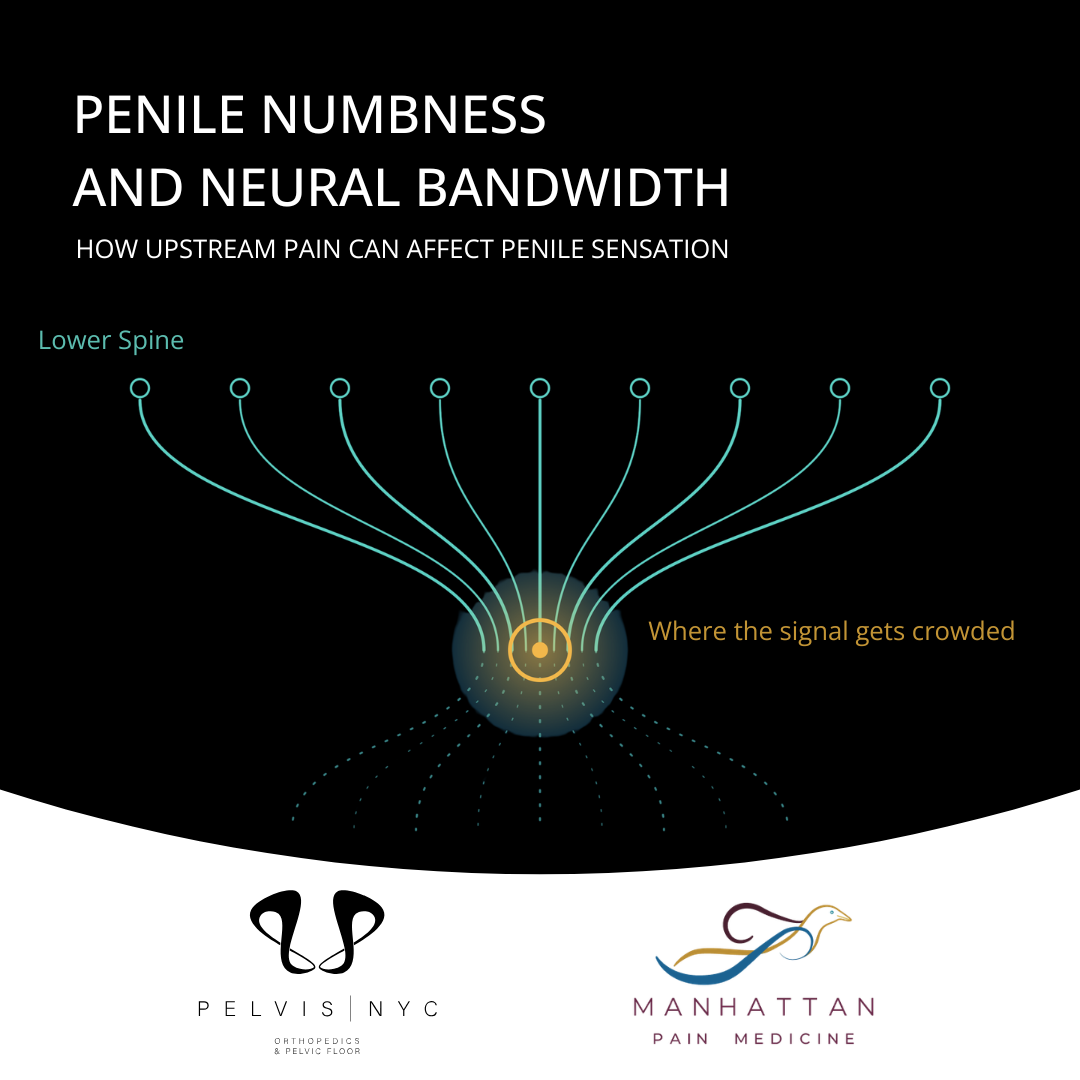
Think of that pathway as a cable with limited bandwidth. Any point along it that gets compressed or irritated can reduce what actually reaches the end of the line. A bike seat, a desk chair, a tight pelvic floor, or a disc issue in the lower back can each play this role. A little irritation at one point might not be noticeable on its own. Irritation stacked across several points, or one significant compression, can be enough to blunt what arrives.

This is why two men with the same symptom can have entirely different sources. One case may involve nerve entrapment in the pelvis. Another may come from chronic pressure on a bike seat. A third may trace back to a disc issue compressing a nerve root before it ever reaches the pelvis. These symptoms can happen for different reasons and are not always compression-based.

Often Overlooked

There is another piece to this that is easy to overlook. The spinal cord does more than pass sensory information along. It also helps regulate how that information is processed. When persistent pain signals are coming from the pelvis, groin, hip, or lower back, the way other sensations are perceived may change.

At Manhattan Pain Medicine, Dr. Jason Siefferman considers this interaction when a patient has reduced penile sensation alongside chronic regional pain. The problem may involve direct nerve compression, altered sensory processing, or several overlapping mechanisms.

Think of it as neural bandwidth. When the nervous system is dealing with persistent pain and irritation, other sensations may become less noticeable. That doesn’t mean the nerve has been permanently damaged. It also doesn’t mean every case of numbness is caused by this mechanism. The question is which explanation actually fits the patient’s symptoms and examination.

Why a Standard Workup Can Miss the Cause of Penile Numbness

Because the symptom is felt at the penis, most initial workups stop there:

Common first stepWhat it checksWhy the source may still be missed
Urological examStructure, blood flow, visible abnormalityDoesn’t assess nerve conduction along the full pathway
Hormone or vascular workupTestosterone, blood flowNumbness from nerve compression won’t show up here
Assuming it’s medication or stress relatedMood, SSRIs, other medicationsMay muddy the picture but doesn’t rule out a mechanical cause
General physical examReflexes, obvious deficitsRarely maps the pathway above the perineum

Psychological factors, including stress and anxiety, can also change how sensory signals are perceived. If medication is a contributing factor, symptoms may improve once a doctor adjusts or switches antidepressants to find the correct approach. Being able to describe exactly how the penis can feel may also help separate medication, psychological, and mechanical patterns.

Some men also notice perineal numbness, or a burning or tingling quality to the sensation. That combination points toward pudendal neuralgia rather than a purely local cause, and it’s easy to miss if the exam doesn’t assess the nerve’s full distribution.

How Pelvis NYC and Manhattan Pain Medicine Trace the Pelvic Floor Source Together

No single exam or provider can pinpoint where sensation is being lost. Finding it means tracing the nerve pathway itself, starting with the likeliest contributors and escalating to targeted diagnostics only when needed.

How does Pelvis NYC trace it?

At Pelvis NYC, that starts with a conversation, not a table exam. The first visit covers sitting posture, cycling and saddle time, sitting for long periods, and any recent change in activity. Prior pelvic or groin injury can also alter nerve pathways, so that history matters too. Many men who notice numbness after cycling or long desk hours find their answer here, before any hands-on exam begins.

Testing Under Real-World Conditions

From there, the assessment moves to the pelvic floor, hip, and lower back. We test under the positions and loads that actually reproduce the symptom, not just at rest. A tight pelvic floor is one of the most common, and most treatable, sources of reduced sensation. Because the pudendal nerve starts at the sacral roots, we also screen the lower back and sacroiliac joints, especially when related symptoms like lower back pain suggest a problem there can produce the same symptom lower down.

Spotting Pudendal Nerve Patterns

This provocation testing is often where early signs of pudendal nerve entrapment, or a broader pattern of pudendal neuralgia, first show up. Penile trauma can also reduce sensitivity through nerve damage, so that history is part of the picture too.

Conservative Treatment Comes First

Treatment usually starts here, before any procedure is considered. Depending on what the assessment finds, this can include pelvic floor downtraining, postural changes, saddle changes or padded shorts for cyclists, special bike shorts to reduce compression, workstation adjustments, and hip or lower back rehabilitation. How sensation responds is itself useful diagnostic information.

When the Pelvic Floor Isn’t the Root Cause

Sometimes, the tight pelvic floor is not the starting point. It may be the body’s response to a painful hip, irritated abdominal wall, or another problem higher up.

A hip that isn’t moving or stabilizing normally can cause surrounding muscles, including the obturator internus, to remain contracted. That muscle sits close to the pudendal nerve’s pathway. Persistent guarding may contribute to nerve irritation even when the original problem is in the hip.

The same principle applies to the pubic symphysis and lower abdominal wall. A sports hernia or painful tendon insertion can generate persistent groin pain and protective muscle tightening without directly compressing the pudendal nerve.

Identifying these patterns during physical therapy gives Manhattan Pain Medicine a more specific starting point for the medical evaluation.

The plan should be individualized to identify the correct source before escalating care, so a provider can match treatment to the source found on assessment. Recovery timelines vary by cause: numbness tied to a clear, recent trigger, like a new saddle, often improves within a few weeks, while more established compression patterns take longer to resolve.

How does MPM trace it?

When sensation doesn’t meaningfully improve, or the examination suggests a more complex nerve problem, Manhattan Pain Medicine adds another layer of diagnostic information.

Dr. Siefferman starts by asking a specific question: Is the nerve itself being compressed, or is something elsewhere in the pelvis, hip, or lower spine contributing to the sensory changes?

The distinction matters because several different problems can produce similar symptoms.

A tight obturator internus may contribute to irritation along the pudendal nerve’s pathway. A painful pubic symphysis or sports hernia can generate persistent groin pain and secondary muscle guarding. A lower spinal condition may affect the sacral nerve roots before they reach the pelvis.

Sometimes, more than one of these problems is present.

Rather than assuming the numbness comes from the pudendal nerve simply because that nerve supplies the penis, the evaluation looks for findings that connect the patient’s symptoms to a particular anatomical structure.

Using diagnostic blocks to narrow the search

When the examination points toward a specific nerve or painful region, Dr. Siefferman may use an image-guided diagnostic injection to learn more.

A small amount of local anesthetic temporarily changes signaling from the targeted area. The response can help determine whether that structure is contributing to the patient’s symptoms.

For example, if a patient has reduced penile sensation alongside persistent pain around the inguinal canal or pubic symphysis, a targeted injection may help establish whether that painful region is part of the problem.

If the familiar pain improves and penile sensation changes at the same time, that provides useful diagnostic information.

A pudendal nerve block can also help evaluate suspected pudendal nerve involvement, although it may temporarily reduce normal sensation because the nerve carries both pain and touch signals.

The important point is that a response to a block is one piece of the diagnostic picture. It does not automatically prove that a particular nerve is permanently damaged or identify the exact mechanism behind the numbness.

Treatment and the Return to Physical Therapy

What happens after the source is identified?

Treatment depends on what the evaluation finds.

When persistent muscle guarding is contributing to nerve irritation, physical therapy remains central. When the findings suggest a structural hip, pelvic, or spinal problem, treatment needs to address that underlying condition.

In selected patients with a clearly identified musculoskeletal problem, Dr. Siefferman may consider additional treatments, including dextrose prolotherapy or platelet-rich plasma. These are considered according to the underlying diagnosis and are not established treatments for penile numbness itself.

The goal is to address the problem that may be driving the protective muscle response, rather than repeatedly treating the numb area.

The return to physical therapy

Once the medical and physical therapy evaluations have identified the likely contributors, Pelvis NYC can use that information to guide rehabilitation.

Reducing pain or nerve irritation may create an opportunity for the surrounding muscles to stop guarding so intensely. But restoring normal movement, pelvic floor coordination, and tolerance to everyday activities still takes work.

Physical therapy can then focus on rebuilding hip and core control, improving pelvic floor function, and progressively returning to sitting, exercise, and other activities that previously triggered symptoms.

If the numbness returns during rehabilitation, that information can be communicated back to Manhattan Pain Medicine and used to reassess the original diagnosis.

That feedback loop is the value of the collaboration: identifying the source, treating it when appropriate, and restoring normal function.

Why Early Evaluation Matters When Experiencing Penile Numbness

Nerve tissue that stays compressed or irritated for a long time can take longer to recover. In some cases, recovery is incomplete even after the cause is addressed. Persistent numbness should also prompt evaluation for medical causes, such as diabetes-related nerve damage or a neurological disease like multiple sclerosis, which can cause significant loss of penile sensation.

Chronic conditions like diabetes should be managed early, and lifestyle changes, heavy alcohol use, or vitamin deficiency should also be addressed to protect nerve function throughout the body. The earlier a contributing factor, whether it’s a saddle, a posture, a tight pelvic floor, or something further upstream, is identified and modified, the better the odds of a full recovery. Seek medical attention if symptoms persist.

Frequently asked questions

Is penile numbness the same as erectile dysfunction or other sexual dysfunction?

No, though they often occur together, since sensory and vascular pathways run through overlapping regions. Penile numbness refers to reduced sensation, while erectile dysfunction refers to difficulty achieving or maintaining an erection.

Can cycling cause penile numbness?

Yes. Prolonged pressure on the perineum from a bicycle seat is one of the most recognized, often reversible causes in people experiencing penile numbness after cycling. It directly compresses the nerves and blood vessels traveling through that area.

Can a lower back problem or reduced blood flow cause numbness in the penis?

It can. The pudendal nerve starts at sacral nerve roots, so an issue higher up, including in the lower spine, can produce sensory changes felt at the genitals rather than the back. If numbness starts after trauma, especially with severe pain, swelling, or deformity during erections, seek urgent evaluation, since a penile fracture can cause both pain and loss of sensation.

Do I need surgery for penile numbness?

Not usually. Most cases are not permanent. Even when hormonal issues contribute to symptoms, surgery is uncommon. Most cases improve by identifying and modifying the contributing factor, whether that’s posture, pelvic floor tension, or cycling habits. Nerve decompression surgery is considered only when entrapment is clearly confirmed, and conservative treatment hasn’t helped. If testing shows low testosterone, treatment may instead focus on correcting that. Testosterone replacement therapy can address lower libido and reduced sensitivity tied to low testosterone.

Can physical therapy help restore sensation?

Physical therapy can address pelvic floor tension, posture, hip mechanics, and nerve mobility, all of which can contribute to reduced sensation. Improvement often depends on how long the symptom has been present and whether the cause is mechanical or medical. Pelvic floor therapy works best when muscle tension or dysfunction is the driver, and it helps most when paired with the right overall plan. If symptoms persist, consult a healthcare provider, especially if sensation does not return to what feels normal.

Is penile numbness a sign of pudendal neuralgia?

It can be. Pudendal neuralgia describes pain or altered sensation along the pudendal nerve’s path, including the penis, scrotum, perineum, and rectum, though a numb penis can also result from certain medication side effects. Symptoms can also follow masturbation-related irritation or minor trauma, and the specific site of symptoms matters during evaluation. Numbness alongside perineal numbness is worth assessing rather than dismissing, especially if it’s worse with sitting.

Reduced sensation isn't something to just live with, and it isn't always a sign of a serious problem. Often it's a signal that something along the pathway needs attention. Schedule your first appointment at Pelvis NYC or call (929) 590-3445.

Dr. Adam Gvili, PT, DPT

Dr. Adam Gvili is the founder and lead clinician at Pelvis NYC, a pelvic floor and orthopedic physical therapy clinic in Chelsea, New York City. He specializes in male pelvic health, chronic pelvic and genital pain, nerve-related sensory changes, and orthopedic rehabilitation.

Clinical collaboration: Jason W. Siefferman, MD

Dr. Jason W. Siefferman is the Founder and Medical Director of Manhattan Pain Medicine in New York City.

Triple board-certified in Physical Medicine and Rehabilitation, Pain Medicine, and Headache Medicine, he specializes in understanding complex and persistent pain conditions, including overlapping musculoskeletal, neurological, and pelvic pain disorders.

He is the author of Pain, Answered and host of the weekly podcast Care Beyond the Pain, where he explores the complexities of chronic pain, diagnosis, treatment, and recovery.

His diagnosis-first approach focuses on identifying what is generating symptoms and coordinating treatment that addresses both the underlying problem and its functional consequences.
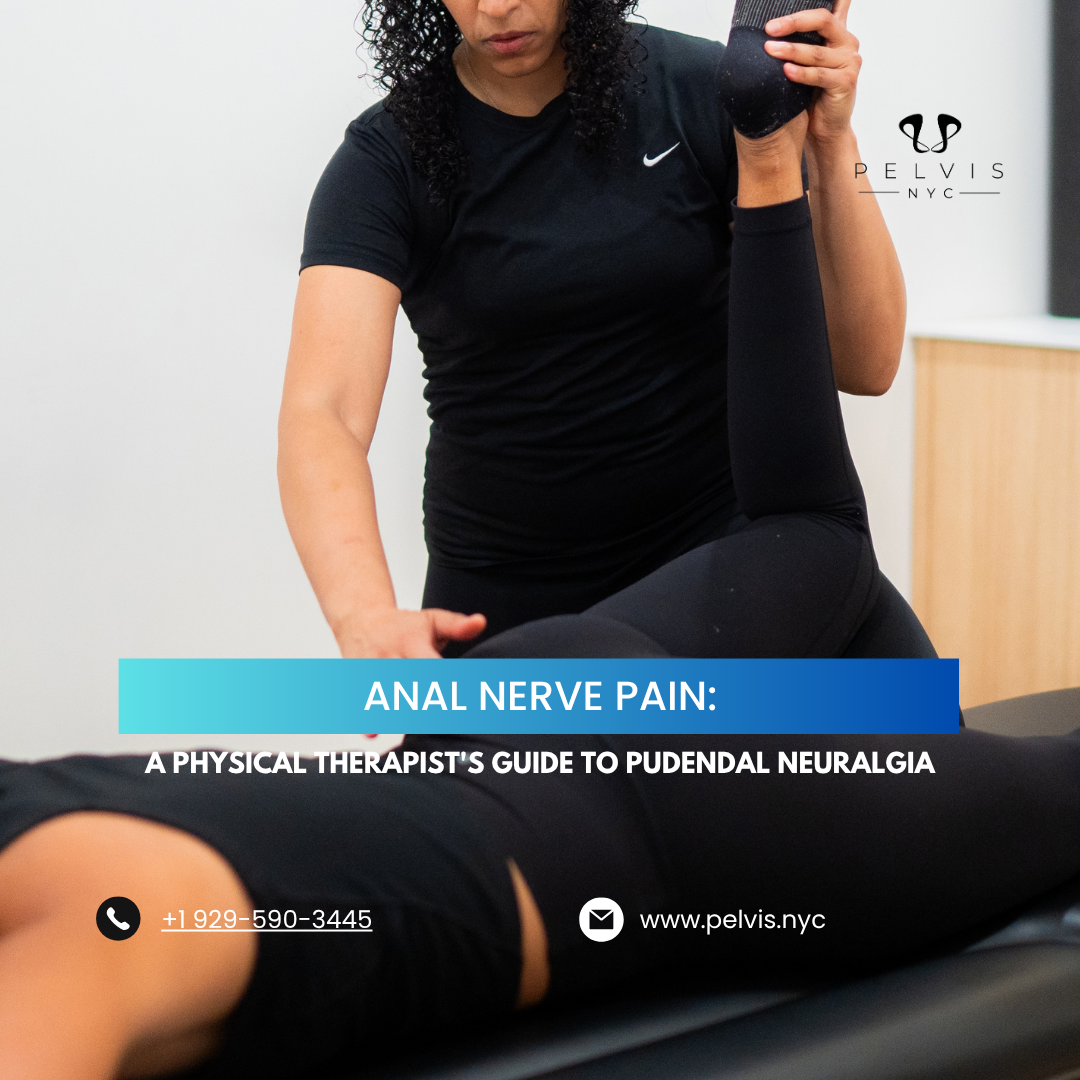

Anal Nerve Pain: A Physical Therapist’s Guide to Pudendal Neuralgia

Anal Nerve Pain: A Physical Therapist's Guide to Pudendal Neuralgia

I’m Dr. Adam Gvili, a physical therapist who works with pelvic pain that many people feel too embarrassed to bring up. If you’re dealing with anal or pelvic nerve pain, this guide explains what may be going on, how it’s diagnosed, and what treatment can look like, from conservative care to surgery. It is a treatable problem, and the right explanation is often the first thing that helps.

Key takeaways

  • Burning, stabbing, or electric-shock pain around the anus is sometimes caused by irritation or entrapment of the pudendal nerve, a condition called pudendal neuralgia.
  • Other conditions can look similar, so an accurate evaluation matters.
  • Pelvic floor physical therapy is usually the first step in care, and many people improve with a consistent, individualized plan.
  • Some symptoms need urgent medical attention (see the red flags below).

What Is Anal Nerve Pain?

Most nerve-related pain in and around the anus involves the pudendal nerve. This nerve carries sensation from the anus, perineum, and genitals, and it supplies some of the pelvic floor muscles. When it is irritated or compressed, people describe burning, stabbing, or electric-shock-like pain, along with pressure, numbness, or a raw feeling. Many people see several providers over months before getting a clear explanation.

Common Symptoms of Anal Nerve Pain

  • Burning pelvic floor pain that builds as the day goes on
  • Perineal pain when sitting, especially on hard surfaces
  • Shooting, electric pain that travels toward the rectum or genitals
  • A feeling of pressure or fullness in the rectum with no obvious cause
  • Discomfort during or after bowel movements that lingers for hours
  • Pain that eases when standing or lying down but returns with sitting

Other Causes of Anal Pain to Rule Out

Not all anal pain is nerve pain. Before assuming pudendal neuralgia, a provider will want to consider:

  • Hemorrhoids or anal fissures, which often cause pain with bowel movements or bleeding
  • Perianal abscess or infection, which usually brings swelling, warmth, or fever
  • Proctalgia fugax, sudden, severe rectal pain that comes and goes within minutes
  • Coccydynia (tailbone pain), often worse when moving from sitting to standing
  • Levator ani syndrome, a chronic ache from tension in the pelvic floor muscles that may overlap with nerve symptoms
  • Prostatitis or chronic pelvic pain syndrome in men

Other conditions such as piriformis syndrome or, rarely, neurological disease like multiple sclerosis and less common pain disorders such as complex regional pain syndrome can also play a role when the picture doesn’t fit.

Red Flags: Get Urgent Medical Care

Don’t wait for a therapy appointment if you have:

  • Rectal bleeding, or blood in your stool
  • Fever, chills, or a swollen, hot, or draining area near the anus
  • Sudden numbness in the groin or inner thighs
  • New loss of bowel or bladder control, or trouble urinating
  • Unexplained weight loss along with pelvic pain
  • Severe pain that comes on suddenly

What Causes Pudendal Neuralgia?

The pudendal nerve travels a narrow, winding path through the pelvis. It passes between ligaments and muscles and through a tight fascial tunnel (Alcock’s canal), so there are several places where it can be compressed or irritated. The pudendal nerve controls movement and sensation in the pelvic area, including normal urethral and anal sphincter function. Common causes of pudendal neuralgia and risk factors for pudendal nerve entrapment can include:

  • Injury: childbirth, pelvic or groin surgery, or trauma
  • Prolonged sitting: sustained pressure on the pelvic area, particularly on hard seats, or other activities that keep putting pressure on the nerve
  • Cycling: repetitive pressure from a saddle
  • Chronic constipation and straining: repeated strain on the pelvic floor and nearby nerves
  • Muscle tension: overactive or guarded pelvic floor muscles, or tight or scarred surrounding tissue, can compress the nerve
  • Pelvic floor dysfunction: which can overlap with levator ani syndrome

These are among the most common causes of pudendal neuralgia, though infections, tumors, or swollen tissues can also contribute, and sometimes the exact cause is unclear. Pudendal neuralgia affects about 1% of the general population, and about two-thirds of diagnosed patients are female. Neuropathic pain also tends to respond poorly to standard over-the-counter painkillers, which is one reason people feel stuck.

Pudendal Neuralgia in Men

In men, pain often shows up in the scrotum, penis, or rectal area. It is commonly described as burning or aching that worsens with sitting or cycling. Because it is sometimes mistaken for prostatitis, a careful pelvic pain evaluation matters. Tight pelvic floor muscles and prior groin or hernia surgery are frequent contributing factors, and some men also experience sexual dysfunction.

Pudendal Neuralgia in Women

In women, symptoms commonly begin after vaginal delivery, pelvic surgery, or a period of chronic muscle tension. Burning pain in the vulva, perineum, or rectal area is typical, and it often worsens through the day and settles overnight. Postpartum pelvic floor dysfunction is one of the most common contributors I see, and pelvic organ prolapse or prior prolapse repair can contribute as well.

How Pudendal Neuralgia Is Diagnosed

No single test confirms pudendal neuralgia, and diagnosing pudendal neuralgia relies on a detailed history, a thorough physical examination, and selected diagnostic testing rather than any one confirmatory study; clinicians often use the Nantes criteria:

  1. Pain in the area supplied by the pudendal nerve (from the anus to the genitals)
  2. Pain that is worse with sitting
  3. Pain that does not wake you at night
  4. No objective sensory loss on examination
  5. Pain relief after a diagnostic pudendal nerve block

For an accurate diagnosis, pudendal neuralgia diagnosed in practice depends on clinical findings plus tests that exclude other causes and, at times, confirm nerve involvement.

Imaging, such as MRI or magnetic resonance neurography, is mainly used to rule out other causes and sometimes to help localize compression. Diagnostic testing may also include nerve studies and, in some settings, quantitative warm-sensory threshold testing to assess pudendal nerve function. Nerve conduction testing can be normal even when symptoms are real. A pelvic floor physical therapist can also assess muscle tone, mobility, and nerve tension as part of the workup, and the physical examination may include pelvic and perineal palpation with assessment near the sacrospinous ligament when symptoms suggest entrapment.

Treatment for Anal Nerve Pain: Where We Usually Start

How pudendal neuralgia is treated depends on the cause, your symptom pattern, and how you respond, so pudendal neuralgia treated successfully usually requires an individualized treatment plan built around several treatment options. Most providers begin with conservative treatments:

  • Pelvic floor physical therapy
  • Changes to sitting and activity habits
  • Pressure-relieving cushions and, if possible, a standing workstation
  • Nerve-calming medications, and muscle relaxants when pelvic floor spasm is a major driver
  • Targeted nerve blocks, where an image-guided injection may include a local anesthetic so pudendal nerve pain can improve temporarily while also helping confirm the diagnosis

About 20% to 30% of patients improve with conservative measures alone. Pudendal nerve blocks have an average success rate of about 80% for symptom relief and diagnostic support.

I want to be direct with my patients: pelvic floor physical therapy is generally considered a first-line approach because it addresses the muscular and mechanical factors that often contribute to nerve irritation. Injections can quiet symptoms while those longer-term factors are worked on.

How I Approach Pelvic Floor Physical Therapy

Every patient starts with a detailed history and hands-on assessment of posture, pelvic alignment, and pelvic floor muscle tone. I may also examine nearby structures, such as the obturator internus muscle, if they reproduce symptoms or show spasm. Treatment may include:

  • Manual therapy to release tight pelvic floor muscles and connective tissue
  • Nerve gliding exercises to reduce tension along the nerve’s pathway
  • Pelvic floor relaxation training, since overactive muscles often drive this pain
  • Postural correction to reduce pressure during daily activities
  • Biofeedback to help you learn to release pelvic floor tension
  • Education on sitting habits and activity changes that protect irritated tissue

Most patients improve when therapy consistently targets muscular overactivity, pressure management, and nerve irritation.

The goal is to reduce mechanical irritation and muscle tension around the nerve. Treatment is never one-size-fits-all, and I adjust the plan based on how your body responds week to week.

When Surgery Is Considered

For severe cases that don’t respond to conservative care, minimally invasive therapies or surgical interventions may be considered. In refractory cases, radiofrequency ablation may be used before or alongside surgery.

This procedure aims to address nerve entrapment, pudendal nerve compression, or pudendal canal syndrome by freeing the nerve from surrounding tissue, often near the sacrospinous and sacrotuberous ligaments, and pudendal nerve decompression or decompression surgery is intended to relieve pressure on irritated nerve fibers. Most surgeons recommend a full course of pelvic floor physical therapy first. Dorsal root ganglion stimulation is an investigational treatment. Reported results vary across studies and depend heavily on patient selection, but surgical decompression has reported success rates of about 60% to 80%, so it’s worth talking through realistic expectations with a surgeon experienced in this procedure. Physical therapy often continues to play a role in recovery afterward.

What Recovery Looks Like

Nerve tissue heals slowly, so consistency matters more than intensity, and recovery can take longer when symptoms involve pudendal neuropathy or prior pudendal nerve damage. Many people notice gradual improvement over weeks to months of regular treatment, though timelines vary. I track progress through symptom changes, sitting tolerance, and functional goals. The aim is not just less pain but getting you back to sitting, working, and living with less constant discomfort.

When to Get Evaluated

Don’t wait until the pain becomes unbearable. Persistent pelvic pain, bowel symptoms, or worsening burning, shooting, or pressure sensations deserve an evaluation. If you have any of the red flags listed above, seek medical care promptly.

For question or inquiry, you may book a FREE 15-minute teleconsultation with us.

Frequently Asked Questions

Does pudendal neuralgia go away?

For many patients, yes. With consistent treatment addressing the underlying muscular and nerve tension, symptoms often improve significantly over time, but outcomes vary, and not all chronic pain resolves with the same approach.

Can the pudendal nerve heal itself?

Nerves can heal, but recovery usually requires reducing the compression or irritation causing the problem. This is exactly what physical therapy targets.

Can pudendal neuralgia be cured?

Many patients reach a point of full or near-full symptom resolution. Outcomes depend on the cause, duration of symptoms, and consistency of treatment. In more severe or persistent cases, surgery is sometimes considered after conservative care fails.

What doctor treats pudendal neuralgia?

Care often involves a team, including a pelvic floor physical therapist, a pain management specialist, and sometimes a urologist or gynecologist. Because symptoms of pudendal neuralgia may include pelvic, genital, or low-back pain along with urinary, bowel, and sexual difficulties, as well as burning, tingling, numbness, and pain with sitting, diagnosis may also involve imaging, nerve blocks, or other testing, and an accurate diagnosis may require specialist evaluation because symptoms can overlap with other chronic pelvic pain conditions before it is confirmed with confidence.

How long does treatment usually take?

Timelines vary by patient, but many people notice meaningful improvement within six to twelve weeks of consistent pelvic floor physical therapy.

Do I need a referral to start pelvic floor physical therapy?

This depends on your location and insurance plan. Our clinic can help you understand what is required before your first visit.

If you are dealing with anal nerve pain and want a clear plan forward, I encourage you to schedule an evaluation at our clinic. Understanding the cause is the first step toward lasting relief.

Dr. Adam Gvili is a Doctor of Physical Therapy specializing in pelvic floor physical therapy and nerve-related pelvic pain conditions.

Occult Inguinal Hernia and Unexplained Testicular Pain: Finding the Hidden Cause

Occult Inguinal Hernia and Unexplained Testicular Pain: Finding the Hidden Cause A collaboration of Pelvis NYC and Manhattan Pain Medicine

You got the ultrasound. Clean. You saw the urologist. Nothing. Bloodwork, normal. And the pain is still there. Pulling, aching, sometimes sharp when you lift, twist, or push through a hard set at the gym. An occult inguinal hernia, also called a hidden hernia, is a small abdominal wall defect that can cause groin and testicular pain without a visible bulge or anything obvious on routine imaging. This is one reason it can be missed in men with otherwise unexplained testicular pain.

Chronic testicular pain, sometimes called chronic orchialgia or chronic scrotal pain, does not always originate in the testicle itself. Nerves, muscles, the abdominal wall, hip, pelvic floor, and inguinal canal can all refer pain into the same area.

If you’ve been told your workup is “normal” but you know something isn’t right, the next step may be looking beyond the testicle itself.

Quick answer: Can an occult hernia cause testicular pain?

Yes. An occult inguinal hernia can cause testicular or groin pain without a visible bulge. It happens when symptoms worsen with lifting, twisting, coughing, bearing down, sprinting, or exercise.

This page explains why hidden hernias can be missed on routine exams and imaging. We will discuss how Pelvis NYC uses a load-based physical therapy assessment to identify suspicious mechanical patterns. How Manhattan Pain Medicine can help determine whether the pain is coming from a small inguinal defect, an irritated nerve, the psoas, or another nearby structure.

That distinction matters because the testicle may be where the pain is felt without being where the problem originates.

Unexplained groin or testicular pain after a normal workup? Book a free 15-minute teleconsultation with Dr. Adam. No referral needed to get started at our Chelsea, NYC clinic.

Sudden or severe testicular pain is different from the chronic pattern discussed in this article and should be evaluated promptly to rule out urgent causes.

What is an occult inguinal hernia and why can it cause testicular pain?

An occult inguinal hernia occurs when tissue pushes through a small weak point in muscle or connective tissue around the inguinal canal.

The inguinal canal is a passage through the lower abdominal wall containing structures and nerves that travel toward the groin and genital region. Unlike a typical inguinal hernia, an occult hernia may be too small or positional to create an obvious bulge.

It may become more apparent only when abdominal pressure increases during standing, lifting, coughing, straining, or a Valsalva maneuver.

Small amounts of fat or other tissue may move through the defect without producing the classic appearance most people associate with a hernia.

The reason this can cause testicular pain is anatomical.

The ilioinguinal, iliohypogastric, and genitofemoral nerves travel through or near this region. Irritation of these nerves can create aching, burning, pulling, sharp, or radiating pain that is perceived in the groin or testicle.

One of the more counterintuitive clinical patterns is that a very small defect can sometimes be disproportionately painful.

A larger opening may allow tissue to move with relatively little resistance. A small fascial opening can create a tighter environment around fat, fascia, and nearby nerves. It produces a combination of local pressure, neuropathic irritation, and protective abdominal muscle guarding.

That guarding can eventually become another source of pain.

Why can an occult hernia be missed on ultrasound, CT, or MRI?

Most men with chronic testicular or groin pain go through a similar diagnostic loop before reaching an answer.

Understanding why a routine workup can be normal is important.

TestWhat it checksWhy the source may still be missed
Urological exam and Doppler ultrasoundTesticular structure, blood flow, torsion, massesThe pain may originate outside the testicle
Standard scrotal or groin ultrasoundSuperficial tissue and visible herniasA small defect can be positional or load-dependent
Bloodwork and STI screeningInfection and inflammationNerve and musculoskeletal causes may produce no abnormal blood markers
Standard physical examBulges, tenderness, reflexesA static examination may not reproduce symptoms that occur under load

At our clinic, we regularly see men who have already been evaluated by multiple specialists without a clear explanation for the pain.

Sometimes the issue is not that the wrong tests were performed. The body was simply being examined under different conditions from those that trigger the symptoms.

How are CT and MRI performed?

Most CT and MRI studies are performed with the patient lying flat. An occult inguinal defect that changes with position or abdominal pressure may therefore be less apparent than it is while the patient is standing, lifting, or bearing down.

When Pelvis NYC’s examination raises suspicion for a hidden hernia, Manhattan Pain Medicine can add a medical and interventional perspective to the workup. Dynamic ultrasound with Valsalva can be useful when the goal is to watch what happens in the inguinal region as abdominal pressure changes.

Dynamic ultrasound has also been supported as a useful first or confirmatory imaging approach when an occult inguinal hernia is suspected.

But imaging alone is not the entire diagnosis.

A small inguinal defect can be present without necessarily explaining the patient’s pain. The imaging findings have to make sense alongside the symptoms, physical examination, and response to diagnostic testing.

How Pelvis NYC evaluates hidden hernia and chronic testicular pain

Dr. Adam Gvili's assessment for occult hernia

Pelvis NYC’s examination is built to identify mechanical patterns that may not appear during a short, static clinical examination.

Instead of only examining the abdomen at rest, we look at what happens to the inguinal canal, abdominal wall, pelvic floor, hip, and associated nerve pathways when the body is actually loaded.

Step 1. Load-based abdominal wall assessment

We assess symptoms during Valsalva, single-leg stance, rotational movement, abdominal loading, and other positions that reproduce the patient’s pain.

A hidden hernia may become symptomatic only when abdominal pressure rises.

Patients may also describe tenderness or pulling in the groin, lower abdomen, or upper thigh that increases with prolonged standing, lifting, coughing, or exercise.

Step 2. Nerve-specific palpation

We assess the anatomical pathways of the ilioinguinal, iliohypogastric, and genitofemoral nerves.

If pressure over a particular area reproduces the same pulling, aching, burning, or sharp sensation the patient recognizes from the groin or testicle, that gives us an important clue about which pathway may be involved.

It does not establish the diagnosis by itself.

The pattern becomes more meaningful when it matches the patient’s history, movement triggers, and other examination findings.

Step 3. Pelvic floor and hip mechanics

Chronic pain around the inguinal region can cause the body to protect itself.

The pelvic floor, hip adductors, abdominal wall, and other surrounding muscles may remain tightened long after the original trigger.

That secondary guarding can contribute to pelvic pain, groin pain, lower abdominal pain, and sometimes symptoms extending toward the hip or lower back.

We assess these patterns as part of the pelvic floor and orthopedic physical therapy evaluation.

The hip is particularly important because some patients can experience symptoms that closely resemble a hidden hernia even when no hernia is found.

When that happens, the anatomical search needs to move higher.

Step 4. Movement and injury history

Many patients can trace the beginning of symptoms to a particular period of physical stress.

It may follow heavy lifting, a hard pivot, a new training program, repetitive abdominal loading, chronic coughing, constipation and straining, or an injury that never completely settled down.

At our clinic, we frequently see active men and NYC professionals who continued training or working through the symptoms because there was no obvious injury or visible hernia.

Reconstructing that timeline can help identify what was happening mechanically when the pain began.

Step 5. Targeted manual therapy and load progression

Physical therapy can address nerve mobility, pelvic floor and hip guarding, abdominal wall function, and progressive tolerance to loading.

For some patients, that resolves the problem.

For others, persistent neuropathic symptoms, recurrent pain under load, prior surgery, or concern for an occult structural defect suggest that another layer of diagnostic information is needed.

This is where collaboration with Manhattan Pain Medicine becomes useful.

Pelvis NYC can identify how the symptoms behave during movement. Manhattan Pain Medicine can help determine which anatomical structure is producing that response.

Related Blog: Hernia Treatment Intervention With Physical Therapy

How Manhattan Pain Medicine confirms the source of testicular and groin pain

At Manhattan Pain Medicine, Dr. Jason W. Siefferman approaches these cases by asking a more specific question than whether a hernia is simply present:

Which structure is generating the patient’s familiar pain, and where along the nerve pathway is the irritation occurring?

A small occult inguinal hernia, local nerve compression, irritation of the genitofemoral nerve higher in the pelvis, post-surgical scar tissue, hip pathology, and secondary abdominal wall guarding can produce overlapping symptoms.

That is why the examination, imaging, and response to targeted diagnostic procedures need to be considered together.

Step 1. Diagnostic ilioinguinal and genitofemoral nerve blocks

An ultrasound-guided diagnostic block can place a small amount of local anesthetic around a suspected nerve, such as the ilioinguinal or genitofemoral nerve.

The response helps localize the pain generator.

If the patient’s familiar groin or testicular pain decreases substantially while that pathway is anesthetized, nerve involvement becomes more likely.

If the expected area of skin becomes numb but the patient’s deeper testicular pain remains, the problem may be occurring farther upstream.

In that sense, a diagnostic block is not simply being used to temporarily relieve pain.

The response itself is part of the diagnostic information.

Nerve blocks are recognized as useful tools for identifying implicated nerves in neuropathic groin and testicular pain, particularly after inguinal hernia surgery.

Step 2. The psoas and genitofemoral nerve: a hidden hernia mimic

The genitofemoral nerve does not begin in the groin.

It originates from the upper lumbar region and passes through the psoas muscle before traveling toward the inguinal canal and genital region.

This creates an important source of referred testicular pain.

If hip instability, a labral injury, or another painful hip condition causes the psoas to remain chronically contracted, that muscle can irritate the nerve as it passes through it.

The result can be a persistent pulling or aching sensation in the testicle that feels very similar to an inguinal hernia.

Chronic testicular pain is known to have possible sources outside the scrotum, including the pelvic floor, hip, spine, and peripheral nerves.

When the examination suggests a more proximal source, a targeted diagnostic procedure can help determine whether reducing the psoas-related irritation changes the familiar testicular symptoms.

Step 3. Treatment follows the confirmed mechanism

Once the likely pain generator has been identified, treatment becomes more specific.

Constipation and abdominal pressure. Repeated straining can continuously increase intra-abdominal pressure and aggravate an already sensitive inguinal region. Addressing bowel function can therefore be an important part of the treatment plan when constipation is present.

Post-surgical nerve entrapment. Testicular or groin pain after inguinal hernia repair may involve the ilioinguinal, iliohypogastric, or genitofemoral nerves. Scar tissue or mesh can contribute to irritation or restriction around these structures.

In selected cases, ultrasound-guided hydrodissection may be considered to separate a nerve from surrounding tissue and improve mobility around it.

Psoas-related nerve irritation. When persistent psoas overactivity appears to be contributing to genitofemoral nerve irritation and physical therapy has plateaued, targeted treatment may be considered. Selected patients may be candidates for botulinum toxin treatment, followed by rehabilitation directed at the hip and movement mechanics that created the guarding pattern.

Persistent peripheral nerve pain. When a specific peripheral nerve has been clearly identified and diagnostic blockade has been helpful, longer-lasting nerve-directed procedures may sometimes be considered in appropriately selected patients.

The objective is not simply to suppress the sensation of pain.

It is to reduce the confirmed pain generator enough to allow the mechanical problem and functional consequences around it to be addressed.

Step 4. When does an occult inguinal hernia need surgery?

Finding a hidden inguinal hernia does not automatically mean that surgery is necessary.

The important question is whether the structural defect actually explains the patient’s symptoms.

Surgical evaluation becomes more compelling when the location of the defect, symptom pattern, physical examination, dynamic imaging, and diagnostic testing point toward the same source.

When that happens, Manhattan Pain Medicine can coordinate evaluation with a surgeon experienced in inguinal hernia and pelvic pain.

Minimally invasive approaches are commonly used for inguinal hernia repair, although the appropriate surgical technique depends on the individual patient and anatomy.

Recent research reinforces why matching the imaging finding to the symptoms matters. Patients with occult inguinal hernias can improve after repair, but not every radiologically detected defect necessarily requires immediate surgery.

The goal is to identify the patient whose hernia is causing the pain, not simply the patient who happens to have a hernia.

Step 5. Returning to physical therapy after treatment

Treating the primary pain generator is not always the end of recovery.

Months or years of pain can change how someone moves.

The abdominal wall may continue guarding. The pelvic floor can remain tense. The hip may avoid load. The patient may unconsciously change how they lift, walk, train, sit, or brace.

This brings the patient back to Pelvis NYC to progressively restore abdominal wall loading, pelvic floor coordination, hip mechanics, mobility, strength, and confidence with exercise.

If the original symptoms recur during rehabilitation, that information can also be communicated back to Manhattan Pain Medicine and used to reassess the pain mechanism rather than automatically repeating treatment.

That feedback loop is the core of the collaboration.

Why does early diagnosis matter for occult hernia and chronic groin pain?

The longer testicular or groin pain continues, the more the surrounding system can adapt to it.

Protective muscle guarding may increase. The pelvic floor may tighten. Nerves can become increasingly sensitive. Movement patterns change.

Eventually, secondary symptoms may persist even after the original trigger has been addressed.

Early evaluation does not mean rushing toward an invasive treatment.

It means identifying whether the problem is primarily structural, neurological, muscular, pelvic-floor related, or a combination before those compensations become more established.

For active men in New York City, whether training, competing in sports, or simply trying to work without persistent groin or testicular pain, that distinction matters.

Frequently asked questions about occult hernia and testicular pain

Can an occult inguinal hernia cause testicular pain without a bulge?

Yes. An occult inguinal hernia can produce groin or referred testicular pain without creating a visible bulge.

Because the defect can be small or position-dependent, symptoms may become more noticeable during lifting, standing, coughing, exercise, or bearing down.

Can a normal ultrasound miss an inguinal hernia?

It can.

Occult hernias can be difficult to identify, and ultrasound results depend partly on the examination technique and examiner experience. Dynamic assessment and Valsalva may improve the ability to identify a suspected defect.

When clinical suspicion remains high despite negative imaging, additional medical evaluation may be appropriate.

Can an inguinal hernia cause chronic testicular pain?

Yes, but a hernia is only one potential cause.

The ilioinguinal and genitofemoral nerves, pelvic floor, hip, lumbar region, prior hernia surgery, and other structures can also refer pain into the testicle.

That is why identifying the actual pain generator matters.

What’s the difference between a hidden hernia and a regular inguinal hernia?

A typical inguinal hernia often creates a visible or palpable bulge.

A hidden or occult inguinal hernia may be smaller and may only become apparent when abdominal pressure increases or the body is placed under load.

Do all occult inguinal hernias require surgery?

No.

A small defect on imaging does not automatically establish that the hernia is responsible for the patient’s symptoms.

Treatment depends on whether the hernia correlates with the clinical pattern and whether other causes of groin or testicular pain have been identified.

What if I have testicular pain but no hernia is found?

The evaluation should broaden rather than stop.

The genitofemoral nerve travels through the psoas muscle before reaching the groin. Pelvic floor tension, hip pathology, abdominal wall pain, nerve entrapment, and referred pain from the spine can also produce symptoms that are felt in the testicle.

Can physical therapy help chronic testicular or groin pain?

Physical therapy may be appropriate when pelvic floor dysfunction, hip mechanics, abdominal wall guarding, musculoskeletal dysfunction, or nerve mobility contribute to the pain.

Pelvis NYC evaluates these factors under movement and load rather than looking only at the location where the pain is felt.

Do I need a referral to see Pelvis NYC for testicular or groin pain?

No referral is required.

New York State’s direct access law allows patients to begin a physical therapy evaluation without first obtaining a physician referral.

Unexplained testicular pain isn't always unexplained. Sometimes the source simply hasn't been identified yet. Schedule your first appointment at Pelvis NYC or call (929) 590-3445.

Dr. Adam Gvili, PT, DPT

Dr. Adam Gvili is the founder and lead clinician at Pelvis NYC, a pelvic floor and orthopedic physical therapy clinic. He specializes in male pelvic health, chronic groin and testicular pain, occult hernia assessment, and orthopedic rehabilitation. He has been featured in Bloomberg, Business Insider, and Experience Life magazine.

Clinical collaboration: Jason W. Siefferman, MD

Dr. Jason W. Siefferman is the Founder and Medical Director of Manhattan Pain Medicine. He is triple board-certified in Physical Medicine and Rehabilitation, Pain Medicine, and Headache Medicine. His clinical approach focuses on identifying the anatomical pain generator and coordinating treatment across overlapping nerve, musculoskeletal, pelvic, and other pain mechanisms.

This article is for educational purposes and does not replace individualized medical evaluation. Persistent testicular, groin, or abdominal pain should be evaluated by an appropriate healthcare professional. Sudden or severe testicular pain warrants prompt medical assessment.