 Skip to content

Effective physical therapy for sports hernia rehabilitation may involve more than strengthening exercises alone. While physical therapy can help improve core stability, hip strength, movement mechanics, and tolerance for athletic activity, persistent groin pain may require additional medical evaluation to identify the underlying cause.
Pelvis NYC and Manhattan Pain Medicine (MPM) offer complementary approaches that may be relevant to individuals experiencing sports-related groin pain. Depending on the diagnosis and the patient’s needs, physical rehabilitation and pain medicine evaluation may each contribute to an appropriate treatment plan.
What Is a Sports Hernia?
A sports hernia, commonly associated with athletic pubalgia, is a cause of activity-related pain in the groin or lower abdominal region. It frequently affects athletes who participate in sports involving rapid acceleration, sudden changes in direction, kicking, twisting, and repetitive high-intensity movements.
Despite its name, a sports hernia is not necessarily a true abdominal or inguinal hernia. The term may describe injuries involving the lower abdominal muscles, tendons, adductor muscles, or related structures around the pubic region.
From our perspective, the key structure is often the pubic aponeurotic plate, where the rectus abdominis and adductor longus meet at the pubic symphysis. Repetitive traction across that junction can create chronic strain or micro-tearing without any true abdominal wall protrusion
Athletes participating in soccer, hockey, football, tennis, and other demanding sports may experience this type of injury.
Common Symptoms of a Sports Hernia
Symptoms can vary depending on the structures involved, but may include:
- Pain in the groin or lower abdomen during exercise, often centered in the groin area.
- Discomfort when sprinting, kicking, twisting, or changing direction.
- Pain during a sit up or resisted abdominal movements; a sit up can be painful and may also be assessed with a resisted sit up during evaluation.
- Tenderness around the pubic region or inner thigh.
- Symptoms that improve with rest but return when athletic activity resumes.
These symptoms can overlap with other conditions, including adductor strains, hip joint disorders, inguinal hernias, and other musculoskeletal injuries.
A qualified healthcare professional should evaluate persistent groin pain to determine its cause. A new groin bulge, severe or worsening pain, or pain accompanied by vomiting or fever warrants prompt medical assessment. A clinician may use a physical exam and imaging tests, including magnetic resonance imaging, to distinguish a sports hernia from an inguinal hernia and check for a visible bulge.
Can Physical Therapy Help With Sports Hernia Rehabilitation?
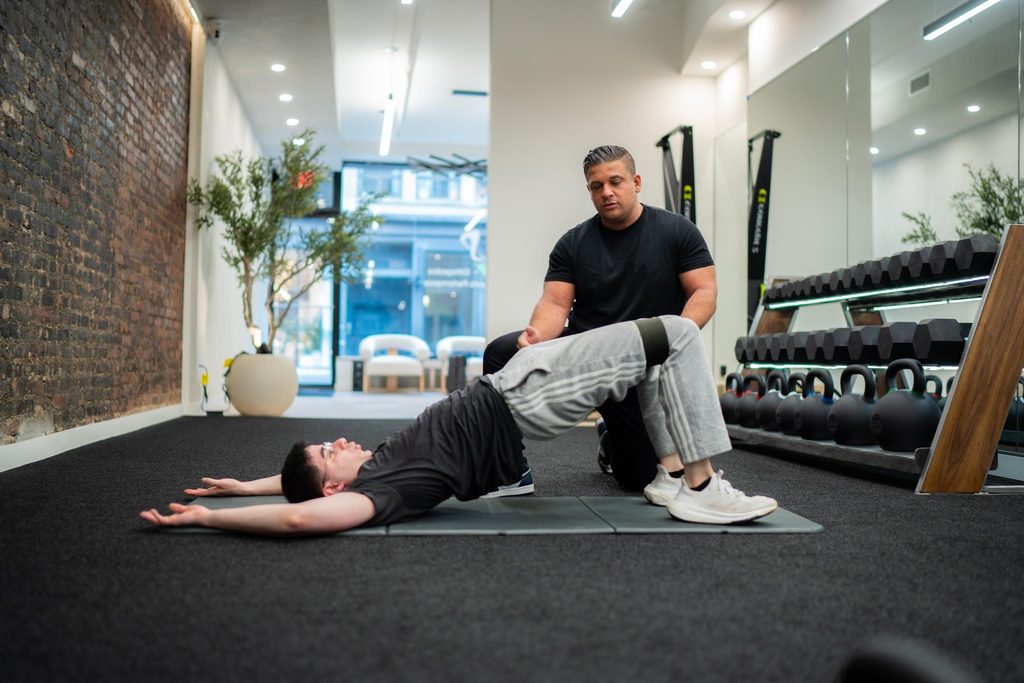
Pelvis NYC takes a comprehensive, movement-focused approach to the conservative management of athletic pubalgia and related groin injuries. Effective rehabilitation goes beyond addressing pain at the pubic region. It requires identifying the underlying biomechanical contributors, restoring optimal muscle function, and improving the coordination of the pelvis, hips, and core to support a safe return to sport and physical activity.
Our Approach to Rehabilitation
The primary goals of physical therapy are to reduce symptom aggravation, restore strength and mobility, improve pelvic and hip control, and progressively reintroduce the demands of sport-specific activity.
At Pelvis NYC, our assessment considers the full kinetic chain and the factors that may contribute to persistent groin pain, including:
- Core strength and abdominal coordination: Evaluating the ability of the abdominal and trunk muscles to manage load and support pelvic stability.
- Hip mobility and strength: Assessing hip range of motion, muscular performance, and movement restrictions that may influence loading around the pubic region.
- Adductor function: Identifying deficits in strength, endurance, coordination, and load tolerance in the muscles responsible for hip adduction.
- Pelvic stability and motor control: Examining how the pelvis and hips coordinate during both static and dynamic activities.
- Sport-specific movement mechanics: Evaluating running, jumping, lifting, acceleration, deceleration, and changes of direction that may reproduce symptoms.
- Training load and symptom response: Understanding how activity volume, intensity, recovery, and movement demands influence the patient’s condition.
When clinically indicated, the examination also includes hip range-of-motion testing, with particular attention to internal and external rotation. These findings can help identify potential hip-related contributors to groin pain and guide decisions about further evaluation.
Individualized, Progressive Rehabilitation
Based on the findings, we develop an individualized rehabilitation program designed to address the patient’s specific impairments and functional goals. Treatment may include progressive core and hip strengthening, adductor loading, pelvic control exercises, movement retraining, activity modification, and graded exposure to sport-specific demands.
The objective is not simply to reduce pain. It is to improve the patient’s capacity to tolerate the forces and movements required for their desired activities while minimizing unnecessary stress on the affected tissues.
Conservative management commonly begins with modifying or temporarily reducing aggravating sports activities. Physical therapy may be combined with appropriate medical management, including anti-inflammatory medication when indicated by the treating medical professional.
Addressing the Underlying Contributors to Persistent Groin Pain
At Pelvis NYC, we recognize that pain around the pubic region does not always tell the entire story. Persistent symptoms may reflect a combination of local tissue irritation and contributing impairments elsewhere in the hip and pelvic region.
Depending on the individual presentation, potential contributors may include femoroacetabular impingement (including cam morphology), hip labral pathology, impaired hip mobility or control, pelvic load-transfer deficits, and sacroiliac-region dysfunction. These conditions do not necessarily cause athletic pubalgia, but they may coexist with it or influence how loads are distributed across the groin and pubic region.
When these contributing factors are overlooked, rehabilitation focused exclusively on the painful area may not fully address the demands placed on the affected tissues. A comprehensive evaluation helps determine whether the treatment plan should be modified or whether additional medical investigation is warranted.
When Further Evaluation Is Necessary
Physical therapy can be effective for selected patients with athletic pubalgia, but it is not the appropriate stand-alone treatment for every cause of groin pain. Some individuals respond well to conservative rehabilitation, while others may require further diagnostic evaluation or consultation with an orthopedic or sports medicine specialist, including consideration of surgical management when appropriate.
At Pelvis NYC, our approach emphasizes identifying the relevant impairments, addressing the factors that contribute to excessive tissue loading, and progressing rehabilitation according to the patient’s clinical presentation and functional response. The goal is a more informed, individualized pathway toward improved function and a safe return to the activities that matter most.
For additional information on diagnosis and treatment, refer to the American Academy of Orthopaedic Surgeons’ guide to sports hernia and athletic pubalgia.
Key Stages of Sports Hernia Physical Therapy
A structured rehabilitation program generally progresses from symptom management to strengthening and sport-specific movement to support a safe return to sports. In appropriate patients, physical therapy can achieve over 90% return-to-sport rates. The pace should depend on the diagnosis, clinical findings, and the patient’s response to treatment.
1. Initial Assessment and Activity Modification
The first stage focuses on identifying the source of pain and understanding which activities aggravate symptoms.
A physical therapist may review the patient’s medical and training history, including how the injury started, what currently triggers symptoms, and whether they continue to play sports despite pain; assess hip and trunk movement; evaluate strength; and identify functional limitations. The physical examination may include palpation around the pubic bone and inguinal canal, along with symptom provocation such as a resisted sit-up when clinically appropriate.
When the hip appears to be driving the adductor guarding, that finding can also help determine whether the pubic symptoms are primary or part of a larger biomechanical chain.
Temporarily modifying painful activities can help manage symptoms while maintaining appropriate conditioning. This does not necessarily mean stopping all physical activity. Sports hernias occur as a soft tissue injury in the lower abdomen or groin and may be linked to forceful motions or twisting movements that require sudden changes of direction.
The goal is to identify a manageable level of movement that does not repeatedly aggravate the injury.
2. Core and Pelvic Stability
The abdominal muscles, hip muscles, and pelvic region work together to control movement during athletic activities.
Depending on the diagnosis, rehabilitation may begin with appropriately selected exercises that improve trunk control and coordination, with deep core activation emphasized early, without placing excessive stress on sensitive tissues.
Examples may include:
- Gentle abdominal bracing and early isometric exercises to support core strengthening and build core stability without excessively loading the injured tissue.
- Modified trunk stabilization exercises.
- Controlled breathing coordinated with movement.
- Low-load hip and pelvic control exercises.
Exercises should be progressed according to symptoms, technique, and clinical findings. An exercise that is suitable for one patient may aggravate another.
3. Hip and Adductor Strengthening
The adductor muscles, which are the inner thigh muscles, work with other thigh muscles to support hip movement and stability during running, kicking, and lateral movements.
When appropriate, rehabilitation may introduce progressive hip and adductor strengthening alongside abdominal and pelvic control exercises.
A program may progress from gentle isometric contractions to resisted hip movements and more demanding functional exercises.
The objective is to improve strength and load tolerance without provoking persistent pain.
4. Functional Strength and Movement Retraining
As basic strength and movement control improve, rehabilitation may incorporate more challenging activities.
Examples can include controlled squats, step-ups, single-leg exercises, balance activities, and progressively demanding movement patterns.
The physical therapist may assess how the patient performs movements that resemble the demands of their sport.
The goal is to transfer strength into practical movement rather than focusing exclusively on isolated muscles.
5. Gradual Return to Running and Sports
Returning to sport too quickly can aggravate symptoms, so a gradual progression supports a safer return to sports, and athletes should not resume full sports activities before meeting rehab goals. Athletes may need a gradual progression from basic conditioning to faster and more complex movements.
Depending on the sport and clinical findings, this progression may include:
- Walking and low-impact conditioning.
- Controlled jogging.
- Faster running and acceleration.
- Direction changes and lateral movements.
- Jumping, kicking, or sport-specific drills, with Phase 4 adding sport-specific and plyometric training.
- Progressive return to practice and competition.
Non-surgical rehabilitation commonly spans 6 to 12 weeks, and full return to sport often occurs within six to twelve weeks when strength, movement quality, and symptoms allow.
Progression should be guided by symptoms, strength, movement quality, and appropriate clinical clearance.
Patients recovering from surgery should follow their operating surgeon’s restrictions and postoperative rehabilitation protocol.
How Long Does Sports Hernia Rehabilitation Take?
There is no single recovery timeline for every sports hernia or athletic pubalgia injury.
Recovery depends on the structures involved, the severity and duration of symptoms, the individual’s activity demands, and whether treatment is conservative or surgical.
Some patients improve over several weeks of appropriately supervised rehabilitation, and many notice sports hernia pain reduction within 4 to 6 weeks of therapy, although timelines vary. Others require a longer treatment period or additional medical evaluation.
Progress should be measured by functional improvements, including:
- Reduced pain during everyday activities.
- Improved hip and trunk strength.
- Better tolerance for progressively demanding exercise.
- Ability to run and change direction without significant symptom aggravation.
- Successful completion of sport-specific movements.
If symptoms persist, worsen, or repeatedly return during rehabilitation, the diagnosis and treatment plan should be reassessed.
Sports Hernia vs. Groin Strain vs. Inguinal Hernia
Understanding the differences between these conditions is important because they may require different treatment approaches.
Sports hernia or athletic pubalgia: Typically refers to activity-related pain and is not a traditional hernia, but rather a soft-tissue problem around the lower abdominal wall and pubic region.
Groin strain: Usually involves an injury to a muscle or tendon, such as the adductors, following sudden loading or overstretching.
Inguinal hernia: Involves tissue protruding through a weak spot or opening in the abdominal tissue near the groin, often creating the visible or palpable bulge more typical of a traditional hernia.
Symptoms can overlap, and more than one condition may be present. A clinical assessment is important before beginning a condition-specific rehabilitation program.
This distinction can sometimes be clarified with dynamic ultrasound. A true inguinal hernia may show tissue moving into the inguinal canal during Valsalva, while athletic pubalgia is more likely to show changes around the adductor or rectus insertion without a true hernia protrusion.
How Manhattan Pain Medicine Can Add Value
When groin pain persists despite appropriate rehabilitation, our role is to determine whether the pubic region is the primary problem or whether something upstream is continuing to overload it.
We look closely at the hip, adductor origin, pubic symphysis, inguinal region, and surrounding nerve pathways. In some patients, the adductor is not simply “tight” or injured; it is working continuously to stabilize a hip with impingement, labral pathology, or another mechanical problem.
When the examination points toward a specific structure, we may use dynamic ultrasound or a targeted image-guided diagnostic injection to test that connection. An injection at the adductor insertion, pubic region, inguinal canal, or hip joint can help show which link in the chain is actually generating the familiar pain.
Treatment then follows the diagnosis. Physical therapy remains central when movement and muscle control are the main drivers. Selected patients with a clearly identified musculoskeletal source may also be considered for image-guided treatment, including regenerative options such as prolotherapy or PRP. When significant structural hip pathology is present, an orthopedic opinion may be appropriate.
The goal is not to treat the painful pubic area in isolation. It is to identify what keeps overloading it so that rehabilitation has a better chance of holding.
Why Coordinated Care May Help
Pain management and physical rehabilitation can serve different but complementary purposes.
Medical evaluation may help clarify a diagnosis and address barriers to activity, while physical therapy focuses on improving movement, strength, and functional performance.
When communication between treating professionals is appropriate and available, a coordinated plan can help align symptom management with rehabilitation goals. This may be particularly useful for patients who have difficulty progressing their exercises because of persistent pain or uncertainty about the underlying diagnosis. Coordinated care may be especially helpful when chronic pain or chronic groin pain makes it hard to progress rehabilitation.
The collaboration is particularly useful when the pubic region is where the patient feels the pain, but the hip or another part of the kinetic chain is what keeps recreating it.
For athletes and active individuals in New York City, physical therapy for sports hernia rehabilitation at Pelvis NYC and an evaluation with Manhattan Pain Medicine may be options to explore, depending on their individual needs.
Learn more about Manhattan Pain Medicine’s approach to pain diagnosis and treatment or explore its musculoskeletal pain services.
Visit Pelvis NYC to learn more about its physical therapy services.
Treatment decisions should be based on an appropriate clinical evaluation. Mentioning both practices does not imply a formal partnership or shared treatment protocol.
When Should You Seek Physical Therapy in NYC?
Consider seeking a professional assessment if groin or lower abdominal pain interferes with running, exercise, lifting, or sports participation.
An evaluation may be particularly helpful when symptoms recur after rest, prevent you from progressing your training, or remain unresolved despite modifying your activity.
Physical therapy for sports hernia rehabilitation can help identify movement limitations, guide appropriate strengthening, and establish functional goals when the diagnosis and clinical presentation support rehabilitation.
A suspected true hernia or another potentially significant cause of groin pain should be assessed by an appropriate medical professional rather than treated solely through exercise.
Frequently Asked Questions
Can physical therapy for sports hernia rehabilitation help without surgery?
Physical therapy can help some individuals with athletic pubalgia and related groin injuries. Conservative sports hernia treatment may include short-term rest from aggravating activity, structured physical therapy, and anti inflammatory drugs when medically appropriate, with surgery reserved for selected cases. However, some cases require further medical assessment or surgery, depending on the underlying condition. Many suitable patients improve without surgery and can ultimately return to sports.
What exercises are used for sports hernia rehabilitation?
Depending on the diagnosis and stage of recovery, a rehabilitation program may include core stabilization, hip strengthening, adductor exercises, balance training, and progressive functional movements. A qualified professional should select and progress exercises based on the individual’s symptoms and capabilities.
Should I continue running with a sports hernia?
Running that aggravates groin or lower abdominal pain should be modified until the cause has been assessed. A gradual return to running may be appropriate when symptoms and functional capacity permit.
Is a sports hernia the same as an inguinal hernia?
No. Athletic pubalgia typically refers to a group of soft-tissue injuries associated with pain in the groin area, and it is not a true hernia; some sources also call it a sportsman’s hernia, though the medical community prefers that term because it more accurately describes the injury. By contrast, an inguinal hernia is a traditional hernia that involves tissue protruding through a weakened area of the abdominal wall and may produce a visible bulge in the groin area. A healthcare professional can help distinguish between them.
Can pain management be combined with sports hernia physical therapy?
Yes. We become involved when pain is limiting rehabilitation or when the source is still unclear. Image-guided diagnostic procedures can help distinguish the painful structure from the mechanical driver, while physical therapy addresses movement, strength, and the compensations around it. The two approaches should complement each other rather than replace one another.
Where can I find physical therapy for sports hernia rehabilitation in NYC?
Pelvis NYC offers physical therapy and sports performance services. Visit Pelvis NYC to explore its services and determine whether an evaluation is appropriate for your needs. Patients with persistent or complex pain may also consider a medical evaluation with an appropriate specialist.
Final Thoughts
Physical therapy for sports hernia rehabilitation can play an important role in restoring strength, improving movement and range of motion, and supporting return to sports when appropriate.
The most effective approach starts with an accurate assessment, progresses at an appropriate pace, and addresses the specific demands of the individual’s daily life and sport.
For patients experiencing persistent groin pain, further medical evaluation may help clarify the diagnosis and determine whether additional treatment is needed. Physical rehabilitation and pain management may complement one another when appropriate for the patient’s condition.
If groin pain is interfering with your ability to exercise or participate in sports, consult a qualified healthcare professional to determine the next steps toward recovery.
Medical References
- American Academy of Orthopaedic Surgeons: Sports Hernia (Athletic Pubalgia)
- Cleveland Clinic: Sports Hernia
- Athletic Pubalgia and Associated Rehabilitation — International Journal of Sports Physical Therapy
This article is intended for educational purposes and does not replace individualized medical advice, diagnosis, or treatment.